Translate

Showing posts with label germany. Show all posts

Thursday, March 14, 2013

genius verus

Aaaand...it's Pi day. :D

Hopefully the majority of my readership is well acquainted with pi, though.  So I thought it might be important to celebrate another event in conjunction with pi day.

Don't worry, fellow nerds...pi is not being abandoned, nor is nerd-dom.  

It's time for a birthday party :D

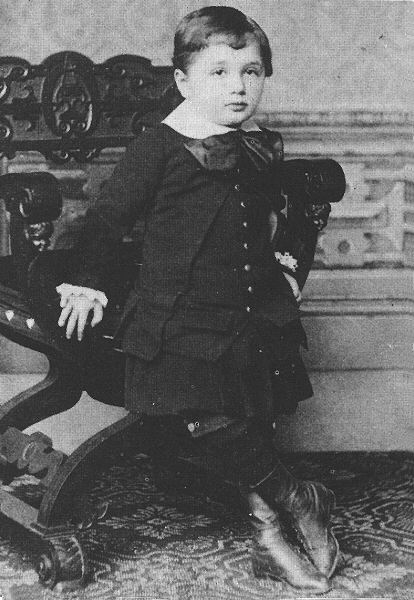
Today in 1879 in Germany, Alberto Einstein was born.  Being German, his parents opted to call him "Albert" for short.  Born on pi day.  He was destined for greatness.
young Albert quickly outgrew the awkward baby stage
and became a dapper young lad.
Most people know the standard Einstein trivia: he was a theoretical physicist, he was a pioneer of the Manhattan project shortly after becoming a US citizen, is one of the more prominent geniuses of history...

I mean, you really cannot dispute the genius of a man whose brain has its own wikipedia article.
By the way, all of the silliness saying that Albert Einstein's brain was significantly smaller than the average man's is...partially true.  We'll have to discuss this fascinating neuroscience later.
(Just don't believe everything you hear about brain sizes; you might begin to believe that women are stupider than men because their brains are smaller.)

So.  Einstein was all about mathematics and physics and the universe and complex stuff like that, right?  Well the funny thing about being human is that you must also dabble in things like religion and arts and other aspects of life.  Man cannot exist on math alone.  Albert Einstein did many things throughout his lifetime.  He learned to play the violin as a child and continued his beloved hobby passionately, perhaps to get his mind off math once in a while.  He went through three marriages and had three children and learned a thing or two about love in the process.  He offered a fair amount of political and theological commentary, as well as physical theories.  His ideas in physics were met with much higher regard, however, leading to a Nobel Prize in physics.

Einstein would often hang out with Niels Bohr (Sorry, that's not a creation of Bram Stoker...it's a scientist) and discuss quantum mechanics.  You know, the way that buddies do. 
Despite being so heavily involved in math and physics, Albert Einstein is quite quotable. Many people seem to think that people who are crazy with the hard sciences are difficult people to understand and are probably too smart to talk to, but I believe that a conversation with Einstein would be fulfilling, enlightening, and enjoyable no matter what your IQ was or where you were in life.

Here are a few quotes of his.  He had many, and it's difficult to choose a favorite. (If you have a favorite, mention it in the commentary of this post!)
  • Everything should be made as simple as possible, but not simpler.
  • Science is a wonderful thing if one does not have to earn one's living at it.
  • The only thing that interferes with my learning is my education.
  • Peace cannot be kept by force. It can only be achieved by understanding.
  • The most incomprehensible thing about the world is that it is comprehensible.
I'm often inclined to list Albert Einstein as a personal hero or inspiring example in my life, and I think the vibe that people get from that is "Oh, look who's the physics hotshot now" which is really not what I'm aiming for.  He was a lot more than just a high-functioning brain somewhere in the universe.  Some science, some philosophy, some music, some religion, some math,  some politics, some love, some humor...


And a whole lot of life.

Monday, February 18, 2013

humanus

So, this choir I'm in just finished working on Brahms' German Requiem.  It's a magnificent piece; if you've never heard it before I recommend you look it up. (The entire requiem is about an hour long, so maybe make a playlist on grooveshark or youtube and just listen to it while you're working on homework or reading...classical music is good for you anyway.)

I'm not going to attempt to conduct any sort of musical analysis here because I'm not much of a musician, but I still think that I can appreciate the music sufficiently to understand what Brahms and I now share.
A nice picture of Brahms looking classy
Although it is not certain, many believe that Brahms' inspiration to compose the piece stemmed from the death of his mother in 1865.  The piece was begun later that same year and finished in 1868.  It is also possible that some of his motivation came from the Schumann family, who a decade previous to this composition had an encounter or two with death.  The second movement is believed to contain some previously discarded material Brahms had written in response to Clara Schumann's mental collapse in 1854.

The work is unique among requiems because while most requiems are traditionally a 'mass for the dead', Brahms' requiem is aimed more toward the living. The German text is brought chiefly from the Bible and communicates a journey through grief and comfort as Brahms (or perhaps the singers, or the audience, or anyone involved at all) learns to put his trust in God and any lingering fear concerning death is converted into a strong faith.

As we prepared to sing this requiem, our choir actually met death a few times; the grandfather of one of our members passed away and she participated in our performance via funeral.  In addition to that, we were informed during our final rehearsal that one of the professors in the music department at our university had been found in his office that morning, dead from a heart attack.  He was young and shouldn't have been at risk for a heart attack, but nevertheless it took him, only a short time after a similar situation took his brother. 

Another music professor told us of his experiences with the Requiem.  When he first prepared to perform it, the time coincided with the death of both his father and his musical mentor, both within a day of each other.  For him, the Requiem offered comfort as he adjusted to life without his fathers.  The next time he participated in the Requiem, he was asked to substitute for someone else who would not be able to perform due to a death.  As he told us of these experiences, he couldn't have known that his colleague was about to leave this realm as well.

It seems that as we immersed ourselves in Brahms' Requiem, we also found ourselves surrounded by news of death. Perhaps there was something about the Requiem that God (or the Universe or whatever you may believe in) found appropriate to call people home with. It seems plausible, but I think if this were the case, paranormal psychologists would be all over the Brahms' Requiem Curse, and...I don't think that's a thing.

What I think is more likely is that the Requiem changed our perspectives and made us more aware of death.  It's a part of life that we sometimes shy away from or find uncomfortable, but in actuality, death is something very dependent upon life.  If you've read Markus Zusaks' The Book Thief, perhaps you'll remember the final chapters of Liesel's life as she embraces death as an old friend.  It's not a particularly happy subject, but it is a  very personal one.
Read The Book Thief.  It's phenomenal.
After journeying through death upon death and realizing that we must all make that journey on our own one day, I understand at least one reason why Brahms later remarked that he would gladly have called the work "Ein menschliches Requiem", or "A Human Requiem", referring more to the audience and the experience of the piece than its distinctive language.

Sunday, December 30, 2012

titulari


As I'm sure you all know, the year is now drawing to a close, and many people like to reflect on the year past.  For Lionel Messi, that includes a record-breaking 91 goals in a calendar year.
 
The record that he broke, though, is also worth reflection. It was previously held by German forward Gerhard "Gerd" Müller, who in 1972 scored 85 goals.  That's right, his record stood for 40 years.

Messi's 91 goals were scored over 69 games, and if you're a Messi fanatic, here's a great website worshipping his accomplishments this year. It has plenty of graphs :)

Müller's 85 goals were scored over 60 games, and if you do the math, Müller, aka "Der Bomber" averaged more goals per game than Messi.  Müller is currently ranked tenth on the list of all-time international goalscorers, despite playing fewer career matches than any player featured in the top 25. He began his professional football career at the age of 18 in 1964. Müller quickly established his value as a striker and made huge appearances in the World Cup, scoring 10 goals in the 1970 games (earning him a Golden Boot*), and scoring the winning goal against Holland to see West Germany take the 1974 Cup.  In these two World Cup appearances, Müller scored a total of 14 goals, setting a record that would not be broken for 32 years.


Müller, far left, all old school and classy. He enjoyed wearing the number 13.

Just to put this in perspective, many records are broken fairly often.  Watch the Olympic Games and you'll see a new record being made in almost every race (track and swimming, for example).  So for a record to stand so far beyond anyone else's reach for 40 years, the person who set that bar is certainly the stuff of legend.

Müller, sometimes teasingly called "short fat Müller" by his earlier coaches and teammates still holds several national and league records, as well as the international record of 66 goals in 74 European Club games.  

And who knows whether Messi will challenge any more of Der Bomber's records.  Messi still has quite a career ahead of him.  Gerd Müller himself congratulated Messi on breaking the record this December, and commented that the Argentine's only fault as a footballer is that he doesn't play for Bayern Munich.

(Hallo to all my German readers...interestingly, I do have a fair number of pageviews from Germany. :D)


*For any soccer illiterates here, the Golden Boot award goes to the World Cup player who has scored the most goals in the tournament.  The last couple awards have gone to players who have scored only 5 goals, and the average number of goals scored by a Golden Boot player is 7.