I don't really write fanfics, but I thought it the best way to honor Alan Rickman and collect some thoughts.
***
He could feel the venom slowly take control. As his final tears fell, the silhouette of Harry gave way to a light that brightened until everything in sight had been consumed. It was Snape's turn to cross over.
Figures began to materialize out of the edge of the light. As he looked around, he began to see faces that he knew. He is met by as mixed of a crowd as he kept during life: his parents, proud to see him again. Charity Burbage, whom he still regrets not saving. Dumbledore greeted him warmly, of course. And death eaters. They had all realized which side he was on by now. Many of them peered sideways at him; the word 'traitor' on their lips. Others must have had a change of heart since dying, and walked up to shake his hand.
He wasn't prepared for any of this.
Severus meandered through the crowded people and memories, still in his lonesome and detached way. It was almost too much to take in. But here he felt a small beam of hope. He began looking.
Far at the back of the crowd, as if waiting for everyone else to finish their greetings, Severus caught a glimpse of dark red hair. He pushed toward it, and was almost caught off-guard when at last he saw Lily. Everything else faded from his view as he quickened his pace toward her.
She offered a smile and he picked her up in an embrace. She still smelled like he remembered.
Lily giggled nervously and said, "It's good to see you, too." Severus stepped back as Lily looked up at James, taking his hand. "I hope it's not too much that we decided to come, Severus."
"Oh, no, Lily, it's delightful to see you," Snape reassured her. "I've been thinking about you, and..."
"Severus," Lily interrupted. "You know that even now we can't go back to how things used to be... I'm sorry." She looked up at him with soft green eyes. Some days, she still missed him.
Snape sighed. Deep down, he knew she was right. She had always been his Lily, and there was a part of her that only he knew. But things had changed, and as much as he loved her, he had to let her go.
That didn't stop it from hurting. Seventeen long years, and it had hurt every day. Seeing her again was just one final heartbreak.
His hair fell into his face as he hung his head. "Then why did you come?" he mumbled.
Lily turned her head to the side, the way she always had when she was worried. "I'm sorry, Severus. I wasn't sure if it was even a good idea, but James--"
"It was my idea, Sev." James stepped in. Snape's stomach dropped further just hearing that voice again. But this time there was something different about his face. It looked somehow softer. It seemed that death had finally wiped the sneer off of James Potter's face.
"I wouldn't let Lily miss it, because I had to see you. I just...I wanted to thank you for taking care of my son."
***
Showing posts with label death. Show all posts
Showing posts with label death. Show all posts
Friday, January 15, 2016


Monday, February 18, 2013
humanus
So, this choir I'm in just finished working on Brahms' German Requiem. It's a magnificent piece; if you've never heard it before I recommend you look it up. (The entire requiem is about an hour long, so maybe make a playlist on grooveshark or youtube and just listen to it while you're working on homework or reading...classical music is good for you anyway.)
I'm not going to attempt to conduct any sort of musical analysis here because I'm not much of a musician, but I still think that I can appreciate the music sufficiently to understand what Brahms and I now share.
Although it is not certain, many believe that Brahms' inspiration to compose the piece stemmed from the death of his mother in 1865. The piece was begun later that same year and finished in 1868. It is also possible that some of his motivation came from the Schumann family, who a decade previous to this composition had an encounter or two with death. The second movement is believed to contain some previously discarded material Brahms had written in response to Clara Schumann's mental collapse in 1854.
The work is unique among requiems because while most requiems are traditionally a 'mass for the dead', Brahms' requiem is aimed more toward the living. The German text is brought chiefly from the Bible and communicates a journey through grief and comfort as Brahms (or perhaps the singers, or the audience, or anyone involved at all) learns to put his trust in God and any lingering fear concerning death is converted into a strong faith.
As we prepared to sing this requiem, our choir actually met death a few times; the grandfather of one of our members passed away and she participated in our performance via funeral. In addition to that, we were informed during our final rehearsal that one of the professors in the music department at our university had been found in his office that morning, dead from a heart attack. He was young and shouldn't have been at risk for a heart attack, but nevertheless it took him, only a short time after a similar situation took his brother.
Another music professor told us of his experiences with the Requiem. When he first prepared to perform it, the time coincided with the death of both his father and his musical mentor, both within a day of each other. For him, the Requiem offered comfort as he adjusted to life without his fathers. The next time he participated in the Requiem, he was asked to substitute for someone else who would not be able to perform due to a death. As he told us of these experiences, he couldn't have known that his colleague was about to leave this realm as well.
It seems that as we immersed ourselves in Brahms' Requiem, we also found ourselves surrounded by news of death. Perhaps there was something about the Requiem that God (or the Universe or whatever you may believe in) found appropriate to call people home with. It seems plausible, but I think if this were the case, paranormal psychologists would be all over the Brahms' Requiem Curse, and...I don't think that's a thing.
What I think is more likely is that the Requiem changed our perspectives and made us more aware of death. It's a part of life that we sometimes shy away from or find uncomfortable, but in actuality, death is something very dependent upon life. If you've read Markus Zusaks' The Book Thief, perhaps you'll remember the final chapters of Liesel's life as she embraces death as an old friend. It's not a particularly happy subject, but it is a very personal one.
After journeying through death upon death and realizing that we must all make that journey on our own one day, I understand at least one reason why Brahms later remarked that he would gladly have called the work "Ein menschliches Requiem", or "A Human Requiem", referring more to the audience and the experience of the piece than its distinctive language.
I'm not going to attempt to conduct any sort of musical analysis here because I'm not much of a musician, but I still think that I can appreciate the music sufficiently to understand what Brahms and I now share.
 |
| A nice picture of Brahms looking classy |
The work is unique among requiems because while most requiems are traditionally a 'mass for the dead', Brahms' requiem is aimed more toward the living. The German text is brought chiefly from the Bible and communicates a journey through grief and comfort as Brahms (or perhaps the singers, or the audience, or anyone involved at all) learns to put his trust in God and any lingering fear concerning death is converted into a strong faith.
As we prepared to sing this requiem, our choir actually met death a few times; the grandfather of one of our members passed away and she participated in our performance via funeral. In addition to that, we were informed during our final rehearsal that one of the professors in the music department at our university had been found in his office that morning, dead from a heart attack. He was young and shouldn't have been at risk for a heart attack, but nevertheless it took him, only a short time after a similar situation took his brother.
Another music professor told us of his experiences with the Requiem. When he first prepared to perform it, the time coincided with the death of both his father and his musical mentor, both within a day of each other. For him, the Requiem offered comfort as he adjusted to life without his fathers. The next time he participated in the Requiem, he was asked to substitute for someone else who would not be able to perform due to a death. As he told us of these experiences, he couldn't have known that his colleague was about to leave this realm as well.
It seems that as we immersed ourselves in Brahms' Requiem, we also found ourselves surrounded by news of death. Perhaps there was something about the Requiem that God (or the Universe or whatever you may believe in) found appropriate to call people home with. It seems plausible, but I think if this were the case, paranormal psychologists would be all over the Brahms' Requiem Curse, and...I don't think that's a thing.
What I think is more likely is that the Requiem changed our perspectives and made us more aware of death. It's a part of life that we sometimes shy away from or find uncomfortable, but in actuality, death is something very dependent upon life. If you've read Markus Zusaks' The Book Thief, perhaps you'll remember the final chapters of Liesel's life as she embraces death as an old friend. It's not a particularly happy subject, but it is a very personal one.
 |
| Read The Book Thief. It's phenomenal. |
Sunday, February 3, 2013
die musicam mortuus
Today in 1959 marked an important day for music: Indeed, it was the Day the Music Died.
Perhaps this phrase is familiar to you. No doubt you've heard it before:
 On February 3, 1959, a plane crash occurred killing rock icons Buddy Holly, Ritchie Valens, and J.P. "The Big Bopper" Richardson, as well as their pilot, Roger Peterson. The flight was disastrous on several levels, the most immediate of which would be the actual crash, which occurred chiefly due to poor weather conditions and unfortunate human error stemming from the pilot.
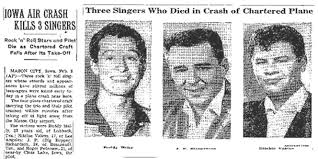 This is not necessarily uncommon knowledge, and the mere fact that a couple musicians died prematurely is nothing new for the music industry, neither is it really grounds to dub the day "The Day the Music Died". That's just overdramatic, right? But there are many lesser-known events surrounding this disaster that deepen the pain for those involved and perhaps justify its poetic title.
Buddy Holly was going on out a musical limb and starting up a group tour with a new band of his and rising artists Valens and Richardson. The tour was not particularly well-planned as many concert dates had failed to take into account the distance between their destinations. Stressful traveling on a poorly-working tour bus led to most tour members contracting influenza, as well as a case of frostbite on drummer Carl Bunch's feet, and frustrated, Buddy Holly decided to charter a plane. Originally the plane would take Holly and his band to their next destination where they would have some time to rest and recuperate before their next show. The other members of the tour would follow along in the infamous tour bus, complete with broken heater. In several turns of events, however, the occupants of the plane were shuffled around:
Dion DiMucci had originally been asked to join the flight, but had passed up his seat because the $36 ticket cost the same amount as the rent for his childhood apartment, and he couldn't justify the lavish expenditure.
Valens asked Tommy Allsup to trade seats, despite his former fear of flight. The two made the decision on a coin toss.
Richardson, the latest sufferer of the flu among the group, asked Waylon Jennings for his seat on the plane. Being in better health, Jennings traded his privilege for a ride on the bus.
When Buddy Holly heard that Jennings had given up his seat, he teased him by saying, "I hope your ol' bus freezes up."
Of course, the only way to respond to such a warm wish is, "Well, I hope your ol' plane crashes."
Jennings' unknowing response shadowed him for the rest of his life.
The crash was a magnificent one. The pilot became disoriented in the low-visibility due to the weather, and various issues with the plane's instruments (specifically the altimeter) combined with the lack of visual cues eventually led to the plane's wing colliding with the ground of a bean patch in Mason City Iowa, a mere five miles after taking off. Upon impact with the ground at 170 miles per hour, the plane continued to tumble for another 600 feet before coming to rest in a mangled wreck against a fence.
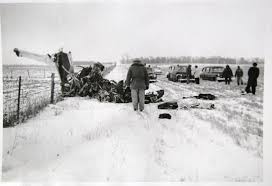
It was declared that all four victims had died instantly from "gross trauma" to the brain.
The reports of the crash were soon aired on television. Holly's bride of six months, María Elena Holly then learned of the disaster and miscarried her two-week-old baby the following day, due to psychological trauma. She did not attend Holly's funeral, neither has she visited his grave site. In part, she blames herself for the accident, believing that had she been with him on the tour, he would not have gotten on that plane.
The tour continued on for two weeks following the incident, with Jennings filling Holly's role as lead singer. The music scene continued on, despite the loss of those three singers. A song was written about them; Three Stars by Eddie Cochrans. Later, Don McLean's more popular American Pie was released, which introduces the title "The Day the Music Died" as it commemorates that fatal crash, as well as several other allusions to events of the time.
So, did the music actually die that day? For some, it certainly did. For most, though, the music just changed and continued on. A few minor chords were struck, and they resonate differently for each of us, but the music still carries us on.
And if you don't think you know any Buddy Holly songs, you're probably wrong.
(Best part of this song? The background clapping. :D )
Perhaps this phrase is familiar to you. No doubt you've heard it before:
Buddy Holly was going on out a musical limb and starting up a group tour with a new band of his and rising artists Valens and Richardson. The tour was not particularly well-planned as many concert dates had failed to take into account the distance between their destinations. Stressful traveling on a poorly-working tour bus led to most tour members contracting influenza, as well as a case of frostbite on drummer Carl Bunch's feet, and frustrated, Buddy Holly decided to charter a plane. Originally the plane would take Holly and his band to their next destination where they would have some time to rest and recuperate before their next show. The other members of the tour would follow along in the infamous tour bus, complete with broken heater. In several turns of events, however, the occupants of the plane were shuffled around:
Dion DiMucci had originally been asked to join the flight, but had passed up his seat because the $36 ticket cost the same amount as the rent for his childhood apartment, and he couldn't justify the lavish expenditure.
Valens asked Tommy Allsup to trade seats, despite his former fear of flight. The two made the decision on a coin toss.
Richardson, the latest sufferer of the flu among the group, asked Waylon Jennings for his seat on the plane. Being in better health, Jennings traded his privilege for a ride on the bus.
When Buddy Holly heard that Jennings had given up his seat, he teased him by saying, "I hope your ol' bus freezes up."
Of course, the only way to respond to such a warm wish is, "Well, I hope your ol' plane crashes."
Jennings' unknowing response shadowed him for the rest of his life.
 |
| Buddy Holly wore hipster glasses before hipsters were cool. |
It was declared that all four victims had died instantly from "gross trauma" to the brain.
The reports of the crash were soon aired on television. Holly's bride of six months, María Elena Holly then learned of the disaster and miscarried her two-week-old baby the following day, due to psychological trauma. She did not attend Holly's funeral, neither has she visited his grave site. In part, she blames herself for the accident, believing that had she been with him on the tour, he would not have gotten on that plane.
The tour continued on for two weeks following the incident, with Jennings filling Holly's role as lead singer. The music scene continued on, despite the loss of those three singers. A song was written about them; Three Stars by Eddie Cochrans. Later, Don McLean's more popular American Pie was released, which introduces the title "The Day the Music Died" as it commemorates that fatal crash, as well as several other allusions to events of the time.
So, did the music actually die that day? For some, it certainly did. For most, though, the music just changed and continued on. A few minor chords were struck, and they resonate differently for each of us, but the music still carries us on.
And if you don't think you know any Buddy Holly songs, you're probably wrong.
Subscribe to:
Posts (Atom)